
 Unit Q, Dodd Lane, Dodd Lane Industrial Estate, Chorley Rd, Westhoughton, BL5 3NA

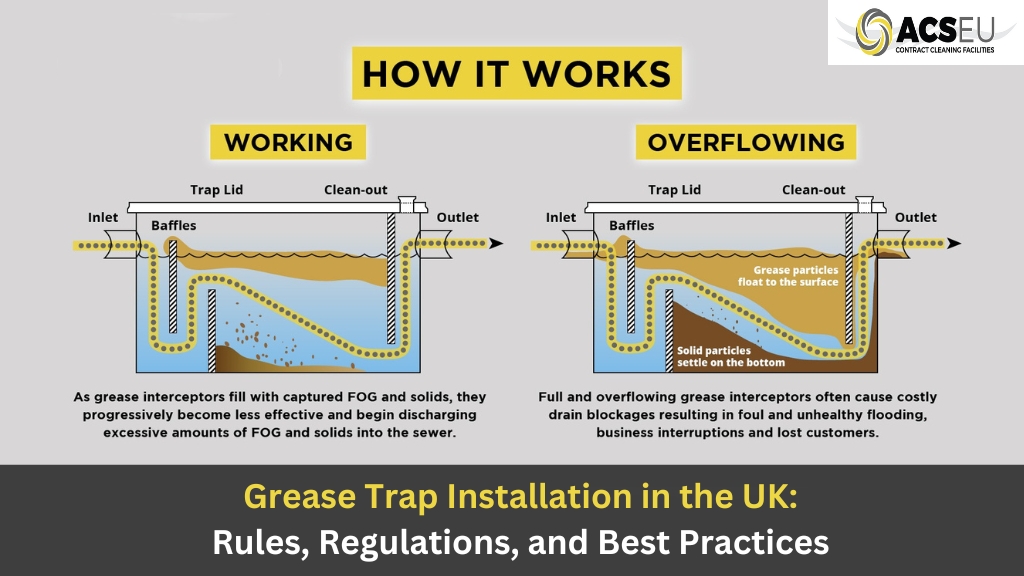
When it comes to running a commercial kitchen in the UK, managing fats, oils, and grease (FOG) correctly isn’t just good hygiene. Also, it’s a legal requirement. Therefore, at ACSEU Limited, we specialise in grease trap installation, grease trap cleaning services, and ongoing grease trap maintenance to ensure businesses stay compliant and avoid the costly consequences of drainage blockages and regulatory fines.
Why Grease Trap Installation Matters
A grease trap (or separator) is a plumbing device designed to intercept FOG before it enters the main drainage or sewage system. As grease cools, it solidifies and can cling to pipe walls over time, this can cause blockages, sewer backups, foul odours, pest attraction, and even pose serious hygiene hazards for commercial kitchens.
For businesses that serve hot food including restaurants, cafés, takeaways, pubs, hotels, hospitals, schools, and food processing facilities installing an appropriate grease management system is effectively non-negotiable.
Even if your kitchen is small, an under-sink grease trap installation can make a difference in protecting your drains and ensuring compliance.
Legal Requirements & Regulations in the UK
In the UK, several pieces of legislation and regulations underpin the need for grease trap installation and maintenance. Key among them is:
- Building Regulations Part H: Specifically, section 2.21 requires that drainage serving kitchens in commercial hot-food premises must be fitted with a grease separator (or other effective grease removal means) compliant with EU/UK standard BS EN 1825-1:2004 (and designed in accordance with BS EN 1825-2:2002).
- Water Industry Act 1991: Under this law, it is a criminal offence to discharge any substance that could interfere with the free flow of wastewater into public sewers, which very much includes FOG.
- Environmental Protection Act 1990: This places a “duty of care” on businesses regarding proper disposal of FOG and other waste.
- Food Safety Act 1990 (and related food hygiene legislation/regulations): Blockages caused by grease that led to drainage or hygiene issues can result in enforcement action, fines, or forced closure.
Failure to comply with these regulations will result in heavy fines, liability for sewer repairs, or even closure of the premises.
In short, if your business serves hot food and disposes of wastewater to mains drainage, you must ensure appropriate grease trap installation and ongoing maintenance.
Best Practices for Grease Trap Installation UK
1) Choose the right type and size
Not all grease traps are created equal. The correct unit depends on the scale of your kitchen, volume of wastewater, and available space:
- Small kitchens or those with limited space may opt for under-sink grease traps or passive grease traps. These are relatively compact and suitable for light FOG output.
- Medium to large kitchens or heavy usage kitchens often need larger-capacity grease separators/interceptors. These are often installed outside the kitchen, sometimes underground or outside the building, with a larger storage capacity. (britishwater.co.uk)
- Consulting with a manufacturer or professional installer, such as ACSEU, to properly size the trap based on anticipated FOG output is a crucial initial step.
2) Position correctly
For under-sink units, the trap should be as close as possible to the sink or source of FOG discharge, while still accessible for maintenance. For larger separators, audio-sewer design standards (e.g. internal drainage standard BS EN 12056 for internal drainage) must be considered to ensure compliant installation of drainage pipework. (United Utilities)
3) Use certified compliant equipment
Always install a unit that complies with BS EN 1825 standards (or UK equivalents), and ensure it is installed properly by certified professionals. Non-compliant or incorrect installation can render the trap ineffective and still risk legal or financial penalties.
4) Plan for the long term cleaning and maintenance
Grease trap installation is only the first step. Without a robust grease trap maintenance and cleaning plan, the trap will quickly clog or overflow. By keeping a detailed maintenance log and cleaning and waste disposal dates, you will be ready for inspections or local authority audits.
Grease Trap Cleaning & Grease Trap Maintenance: Why Regular Service Matters
Even the best-installed grease trap will fail if it isn’t regularly serviced. Over time, fats, oils, grease, and food solids accumulate. Once the contents occupy a significant portion of the trap’s capacity (many guidelines advise around 25%), the trap becomes ineffective. Therefore, grease and solids may escape into drains, risking blockages.
Also, common signs you need cleaning or maintenance: slow-draining sinks, bad odours, pooling wastewater, or gurgling noises in your drainage system.
Cleaning frequency varies with usage: small, busy kitchens will need cleaning every 1–3 months. Whilst larger or outdoor separators may stretch to quarterly or even six-month intervals, depending on volume and waste output.
Many operators choose to use commercial grease trap cleaning services. Indeed, this ensures safe, compliant waste disposal (via licensed waste carriers). Also, helps avoid the risk of putting grease back into the drains.
At ACSEU, we tailor our maintenance schedules to suit each business, whether that means regular vacuum-outs, cleaning internal traps, or servicing external separators.
Why Choose ACSEU for Grease Trap Installation & Maintenance
At ACSEU Limited, we are aware of the regulatory landscape. Due to this, we offer full-service support from the initial grease trap installation in the UK, through to long-term grease trap cleaning and maintenance.
- Our expert team can advise on the correct type and capacity of trap based on your kitchen size and output.
- We install grease traps to meet BS EN 1825 and Building Regulations Part H compliance.
- We offer scheduled cleaning, ongoing maintenance, and emergency clean-outs if needed.
- We follow strict protocols for safe FOG disposal via licensed waste carriers and help you maintain records to demonstrate compliance.
With ACSEU, you get more than just a grease trap. Furthermore, you get peace of mind, regulatory compliance, and a healthier, safer kitchen environment.
Final Thoughts on Rules, Regulations, and Best Practices UK
Overall, grease trap installation is not just a “nice to have” for UK commercial kitchens; it’s often a legal requirement. But installation alone isn’t enough. Without regular grease trap cleaning and maintenance, you risk blockages, fines, environmental damage, and even forced closure.
Whether you need a compact under-sink solution or a large external separator, indeed, it’s essential to plan installation correctly, service regularly, and dispose of waste responsibly. At ACSEU Limited, we’re here to guide you through every step, from under-sink grease trap installation to full-service grease trap maintenance.
So, protect your business, safeguard your drains, and stay compliant. Contact us today to discuss your grease trap needs.